Introduction: The Real Cost of Bucket Teeth
In heavy-duty excavation, bucket teeth are among the most frequently replaced yet most underestimated wear components. When contractors first see the price tag of forged bucket teeth, many are surprised. But after years of working alongside project managers in North American quarries, Australian mining sites, and Middle Eastern earthmoving operations, one truth becomes clear: forged bucket teeth are not expensive — they are an investment.
At Xiamen Doozer Industries Co., Ltd., we have spent over 16 years manufacturing high-quality undercarriage parts and bucket teeth for excavators and bulldozers. Our forged bucket teeth are engineered for the toughest working conditions — and in this article, we explain why they cost more, and why that cost is fully justified.
What Makes Bucket Teeth So Critical?
From an engineering perspective, bucket teeth are far more than simple consumables. They serve as the primary load-bearing interface where nearly all excavation resistance is concentrated. Beyond abrasive wear, bucket teeth endure impact loads, shear forces, and cyclic fatigue stress.
In hard-rock excavation, the geometry and load-transfer paths of bucket teeth directly affect engine load, hydraulic pressure stability, and fuel efficiency. High-quality teeth also protect the bucket body, delay structural wear at the lip and tooth adapter, reduce cutting resistance, and absorb impact energy to minimize fatigue damage to the boom, arm, and linkage. Selecting bucket teeth based solely on initial purchase price is a costly mistake.
Forged vs. Cast: The Manufacturing Difference
Understanding the price difference starts with understanding how bucket teeth are made.
Cast bucket teeth are produced by pouring molten metal into molds. While this method offers lower tooling costs and reduced unit manufacturing expense, it comes with significant drawbacks. Cast teeth frequently exhibit internal porosity, inconsistent grain structure, and brittle fracture under impact loads. In demanding applications, cast teeth require much more frequent replacement.
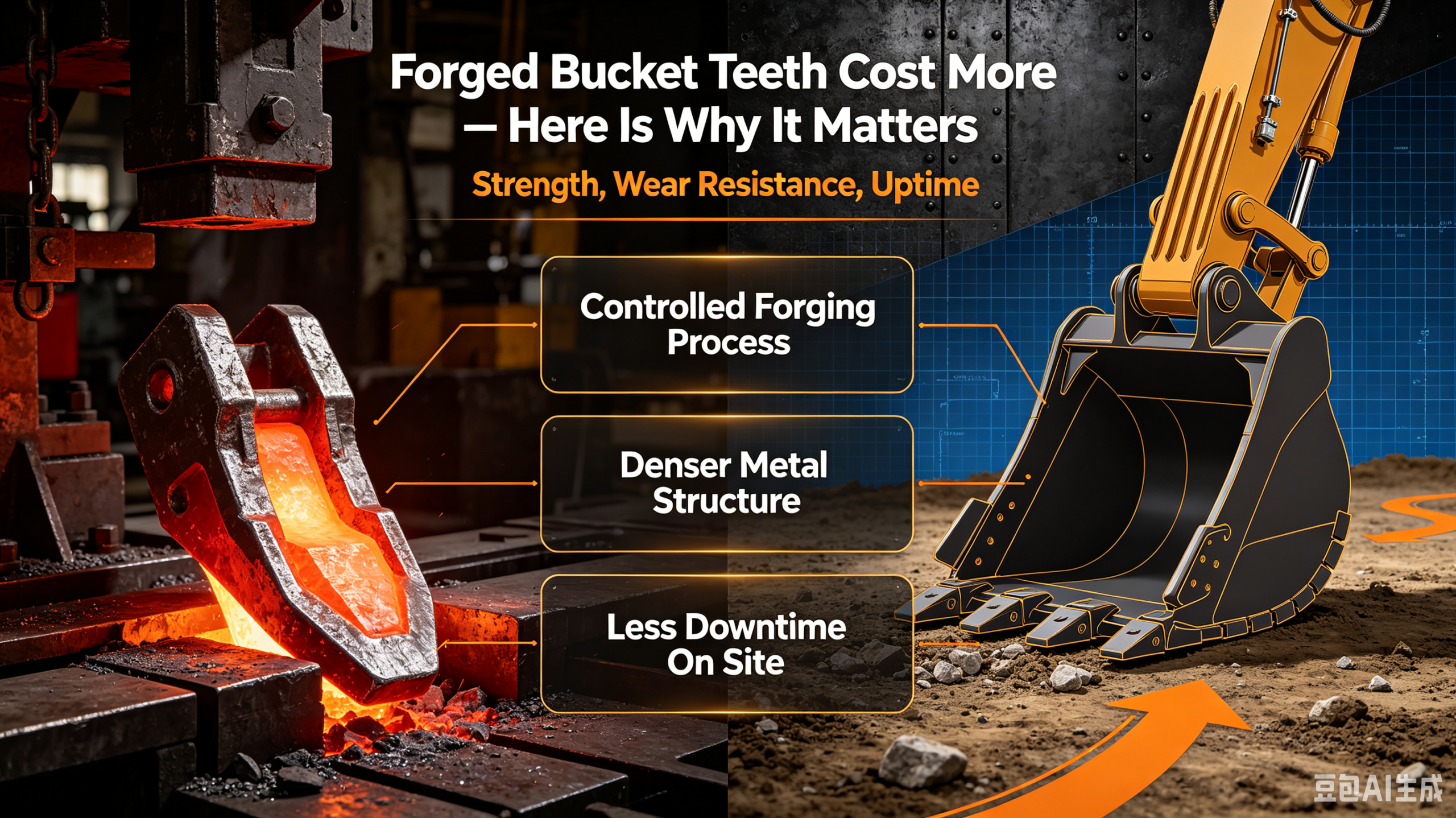
Forged bucket teeth, by contrast, are formed by applying high pressure to heated steel billets, forcing the grain structure to flow along load paths. This process delivers:
Dense internal structure with no porosity
Superior impact resistance and toughness
Significantly extended fatigue life
Across multiple independent projects, forged bucket teeth consistently achieved 1.8 to 2.2 times the service life of cast alternatives under identical operating conditions. Some industry tests report even greater margins — with forged teeth lasting up to 200% longer than cast options.
Why the Higher Upfront Cost?
Many buyers assume forged bucket teeth are expensive simply because they use “better steel.” In reality, the cost drivers are far more complex:
Multi-stage heat treatment processes for optimal hardness and toughness
High-tonnage forging press investment and ongoing die maintenance
Tight dimensional tolerance control for precision fit
Superior alloy steel with hardness levels reaching HRC 51–56
When precision matching with bucket tooth adapters is required, forged components provide more consistent long-term fit and load distribution. This reduces wear on adapters and pins — a hidden saving that adds up over time.
Lifecycle Cost: The Real Picture
The following comparison tells the full story:
| Evaluation Factor | Forged Bucket Teeth | Cast Bucket Teeth |
|---|---|---|
| Initial Purchase Cost | Higher | Lower |
| Service Life | Longer | Shorter |
| Replacement Frequency | Lower | Higher |
| Unplanned Downtime | Minimal | Frequent |
| Total Lifecycle Cost | Lower | Higher |
In high-utilization operations, forged teeth are less prone to deformation during removal, reducing collateral damage to adapters and pins. Field tests have shown that despite a higher upfront price, the cost per operating hour for forged teeth can be significantly lower — approximately $0.85 versus $1.15 for cast teeth.
Why Professional Contractors Choose Xiamen Doozer Forged Teeth
Experienced contractors follow a consistent principle: When operating conditions are unpredictable, prioritize the most reliable component available.
Xiamen Doozer forged bucket teeth are engineered to reduce:
Unplanned stoppages and emergency repairs
Secondary damage to adapters and bucket lips
Overall maintenance costs and machine downtime
In one Australian iron ore mine application, forged bucket teeth achieved over 920 hours of service life — a 104% increase — saving an estimated AUD 128,000 per excavator annually. In another case, a single machine saved over $250,000 annually in reduced tooth consumption, fewer maintenance events, and lower adapter wear.
Conclusion: An Engineering Choice, Not an Expense
So — why do forged bucket teeth cost more? The reasons are clear:
Complex, high-precision manufacturing processes
Superior internal material structure with no porosity
Longer service life under high stress and impact
Lower total cost over the equipment lifecycle
If your operating environment involves high impact loads, abrasive materials, and unpredictable conditions, forged bucket teeth are not simply “expensive” — they are the more rational engineering choice.
At Xiamen Doozer, we don’t just sell bucket teeth. We deliver reliability, longevity, and lower total cost of ownership — because in heavy-duty excavation, every operating hour counts.
Contact us via TEL / WhatsApp / WeChat Quick response within 12 hours

Production Experience

Export Experience

Quality Guaranteed

Fast & Reliable



 +86 1588 0208980

 doozer@doozergroup.com